
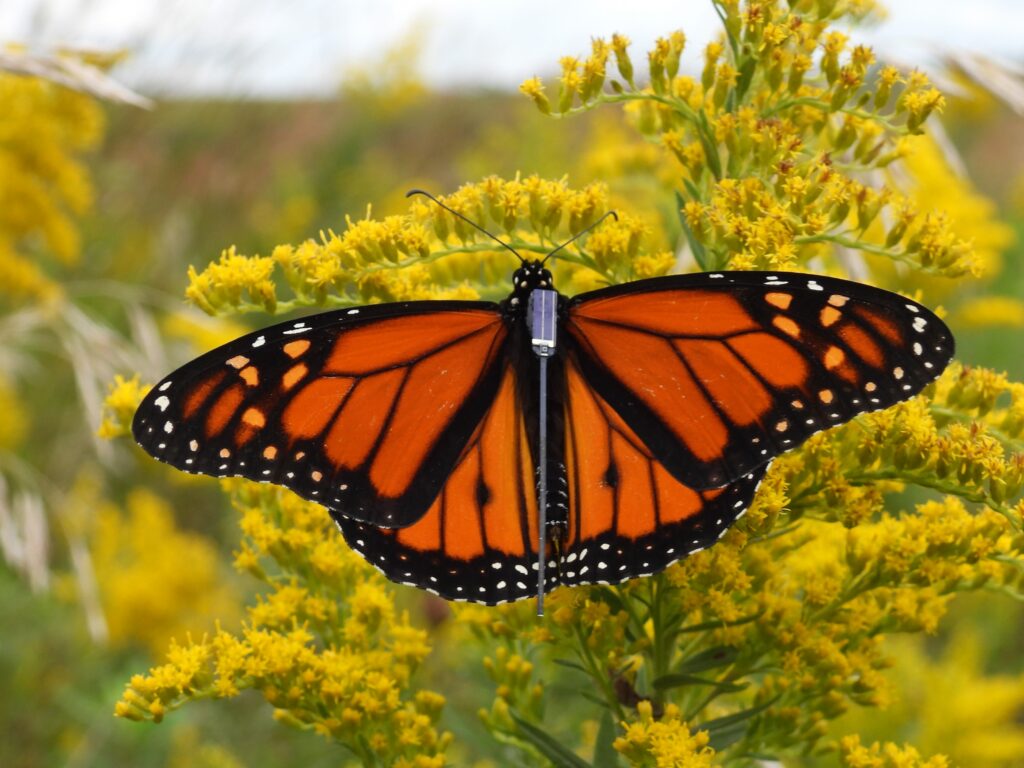
Variation is the norm!
article by Karen Oberhauser, cover photo by Jim Otto
I’ve learned during 41 years of studying monarchs that they’re incredibly variable. My husband was at first surprised when we were watching butterflies and saw multiple monarchs – I could usually tell if we were seeing the same one or different ones. Of course, many people can distinguish males and females, but there are also big and small monarchs, different spotting patterns and colors, and lots of variation in wing wear. This shouldn’t be surprising, given how much variation there is in our own species, but somehow people seem to expect monarchs to all be alike. And their differences aren’t limited to how they look. As I noted in last month’s update, autumn highlights interesting differences in monarch life histories and behaviors.
A new technology is providing a previously impossible window into monarch movement patterns, documenting amazing information and a surprising amount of variation. This technology involves placing tiny solar-powered transmitters (Blū+ tags) to monarchs’ thoraxes. These transmitters weigh about as much as a grain of rice, and send location signals that can be detected by Bluetooth-enabled phones up to about ¼ mile away. The phones are essentially passive receivers that allow detection of fine-scale movements. In 2025 about 400 transmitters were deployed; this number has almost quadrupled in 2026.
Figures 1a-c: Blū+ tag application process
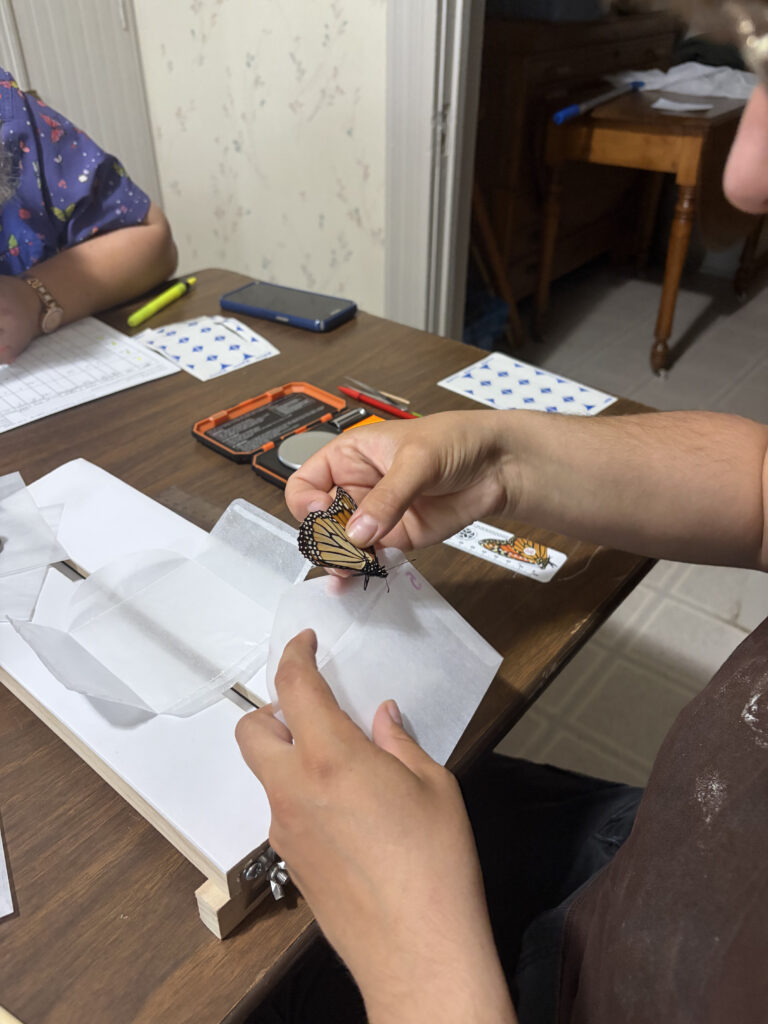
Measurements on wing length, body mass, wing condition, and presence of OE were taken prior to determining if the monarch was suitable for tagging. Photo by Brenna Marsicek/SoWBA
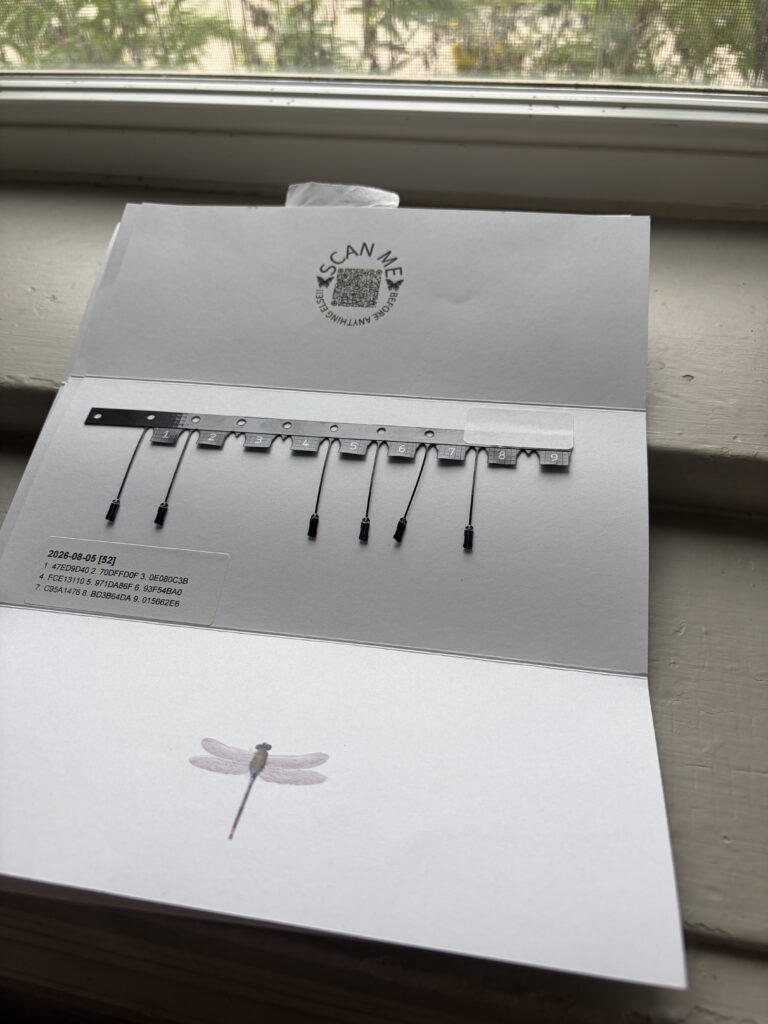
A sheet of transmitters as they arrived in the mail — ready for attaching to a monarch. Photo by Brenna Marsicek/SoWBA
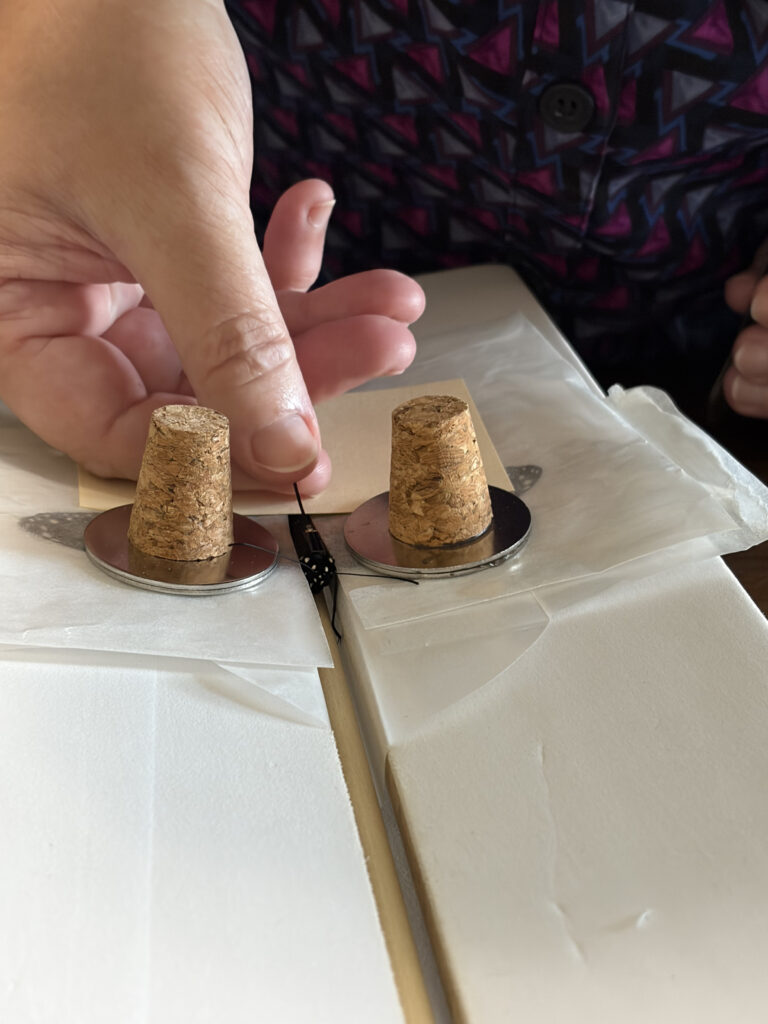
A transmitter is attached to a monarch butterfly at Goose Pond Sanctuary on September 6, 2026. Photo by Brenna Marsicek/SoWBA
If you haven’t already, I recommend that you open the Project Monarch App, preferably on your computer (where the bigger screen provides a better picture of what’s going on). Here’s a taste of what we can learn.
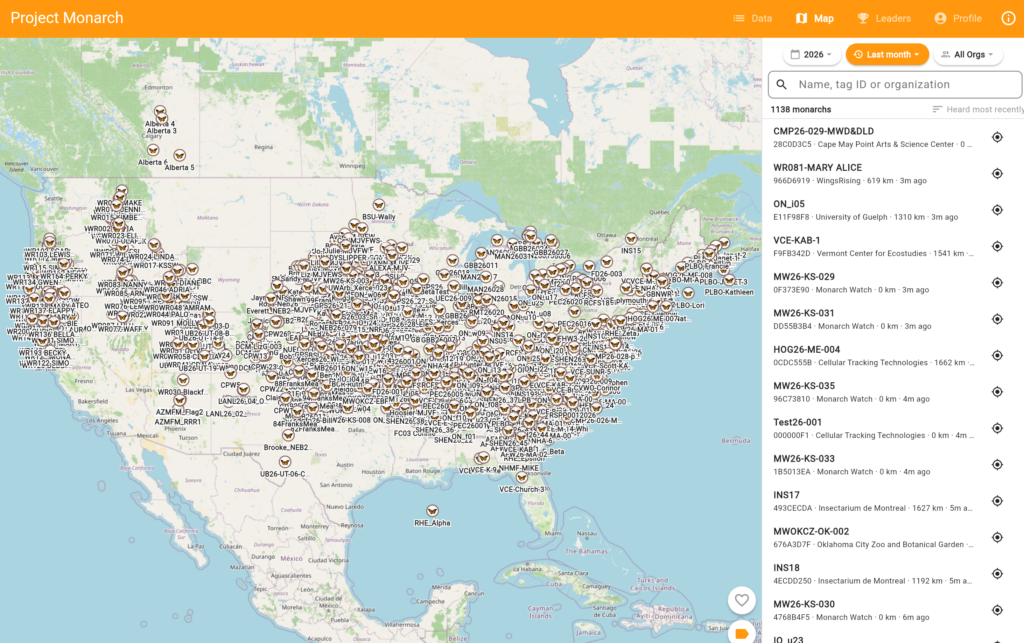
Figure 2 below shows the current location (on September 29) of all the tagged monarchs that have been active over the past month. These monarchs are expected to be migrating. The table on the right shows their last detections. For example, the monarch called WR081-Mary Alice had been detected 3 minutes before I took the screen shot (see the second butterfly on the table).
Figure 2: Blū+ tagged monarchs detected in September
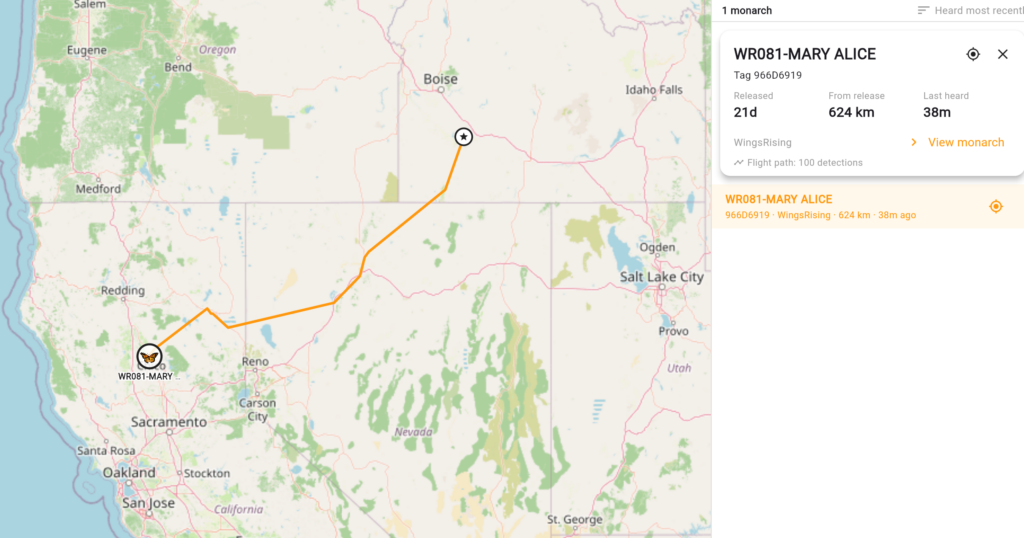
I clicked on Mary Alice, and saw that she had flown from Idaho to California in the past 21 days (see below Figure 3).
Wisconsin Tags. The Southern Wisconsin Bird Alliance (SoWBA), a key WI Monarch Collaborative sponsoring organization, tagged 30 butterflies at Goose Pond Sanctuary (GPS), a SoWBA property through which thousands of migrating monarchs fly every year. GPS has a long history of tagging monarchs with paper stickers, so was a perfect location for a large deployment of the new electronic tags. All tagged monarchs were named with the prefix GPS, making them easy to search for on the app. Figure 4 shows the last detected location of the GPS monarchs on September 29.
Figure 4. Butterflies tagged at Goose Pond Sanctuary in Arlington, Wisconsin, 23 or so days after tagging
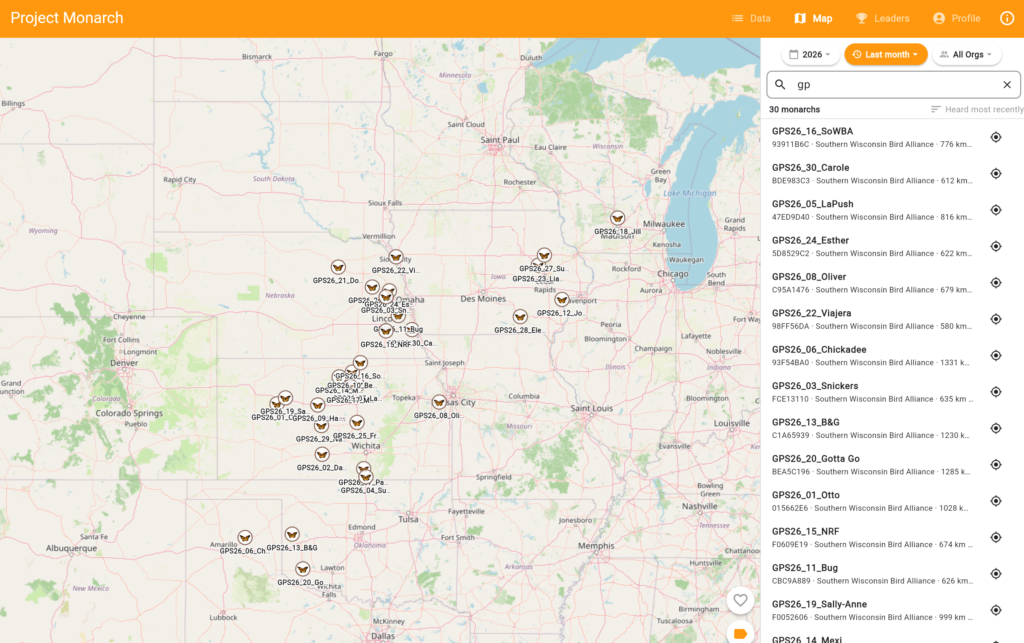
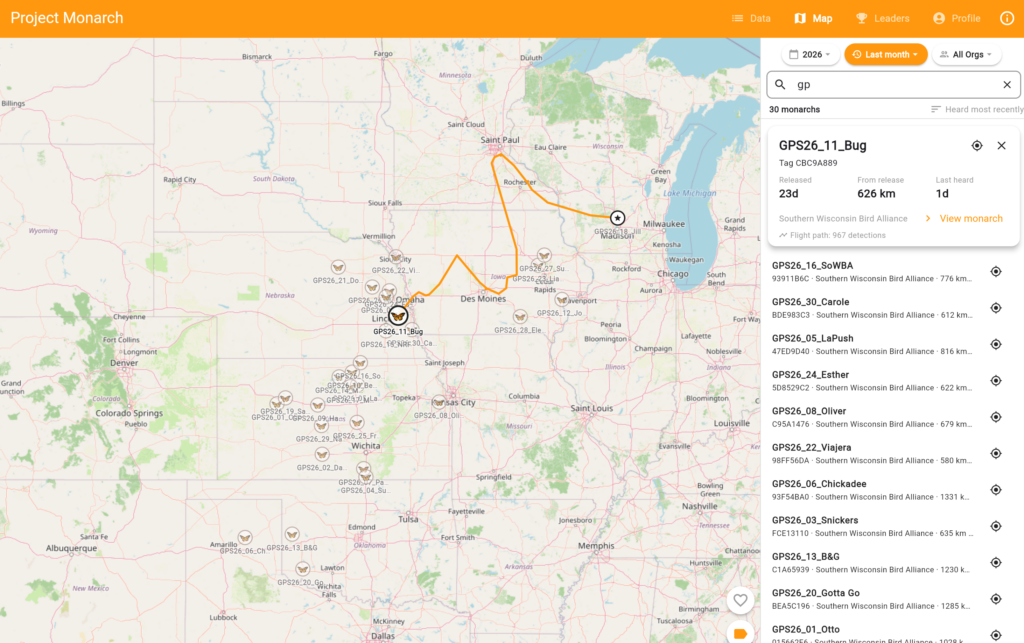
And here is the surprising variation. Figure 4 shows that the Goose Pond monarchs are spread out over a huge area, even though they were released at very similar times. Let’s look at GPS26_11_Bug (Figure 5). This butterfly, a large female (her forewing length was 54 mm; the average is about 50 mm) was released on September 5. She first headed northwest, going almost as far as St. Paul MN before heading south and getting a little south of Omaha by September 28.
Figure 5. Bug’s flight path
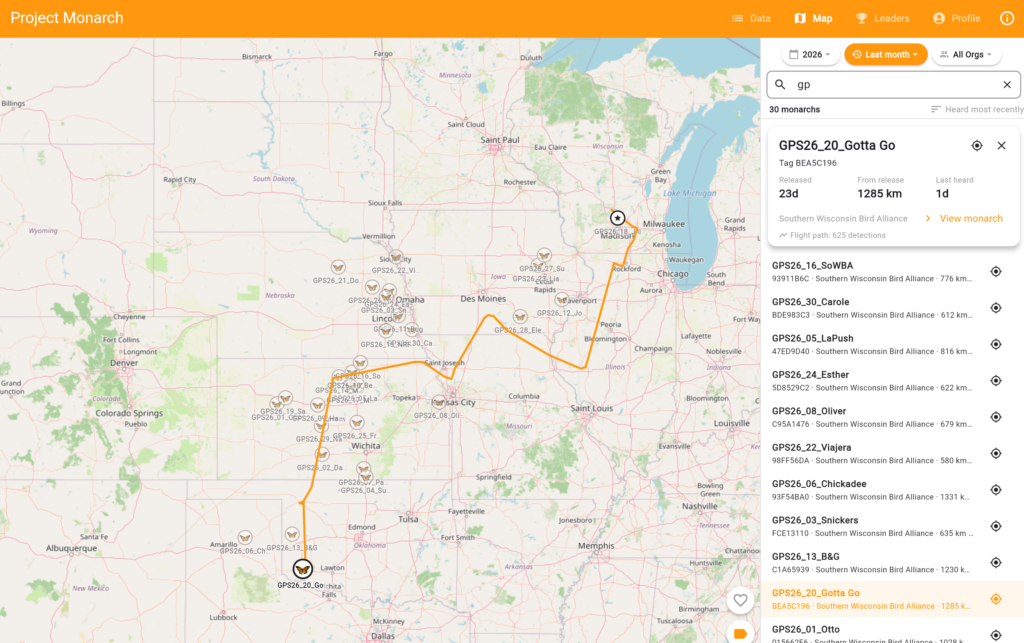
GPS26_20_Gotta Go was a bit more direct (Figure 6). Gotta Go, also a female but smaller (wing length 51 mm), was tagged on September 6 and headed pretty much straight south before turning west and then south again. She is now in OK, almost to the TX border. Perhaps she was encouraged by the name her tagger chose!
Figure 6. Gotta Go’s flight path
As I look at monarchs in the overwintering sites in Mexico, I have often fantasized about knowing their individual stories. I knew they were amazing, but until now, we couldn’t get detailed information on those stories. Of course, we can’t ever know the details of the lives of Mary Alice, Bug, and Gotta Go before they were tagged (although who knows, someday even that information may be available), and if the butterflies die and the transmitters are no longer in sunlight, we won’t know what happened to them. But finally having access to these pathways—and analyzing how they’re affected by wind, temperature, and terrain conditions—is opening the doorway to a whole new understanding of monarch biology.
In Wisconsin, 73 transmitters were deployed this fall—by Southern Wisconsin Bird Alliance at Goose Pond Sanctuary (30), by Beaver Creek Reserve near Eau Claire (20), by Urban Ecology Center in Milwaukee (14), by Xerces Society in the Madison area (5), and by the University of Wisconsin–Madison Biocore program (4).
This project has been a collaborative effort. Our team was trained by Emma Pelton, a biologist with the Xerces Society. Chip Taylor at Monarch Watch provided guidance on the timing of applying the tags—he recommended tagging the butterflies from South Dakota to Michigan so that their release would coincide with all members of the group reaching the 43° latitude at approximately the same time (which would allow him to see how the entire group reaches the wintering grounds in Mexico). Monarch Watch also provided tagging equipment, including scales to weigh the monarchs. We’ve been in close communication with Beaver Creek Reserve, Urban Ecology Center, and UW–Madison Biocore program to share resources and offer lessons learned.
Wisconsin Master Naturalist Samantha Humes and Goose Pond Sanctuary land steward Emma Raasch studied the technique for deploying these trackers so they could do so precisely and compassionately. A small team of volunteers caught dozens of butterflies so we could select the healthiest ones to be tagged. And donors made all of this possible, funding the effort at $200/tag.
It truly takes a village to pull off a project like this! Thank you to everyone who came together to make this happen!
More information is available at swibirds.org/blog/project-monarch-2026 and at swibirds.org/fff/2026/monarchs
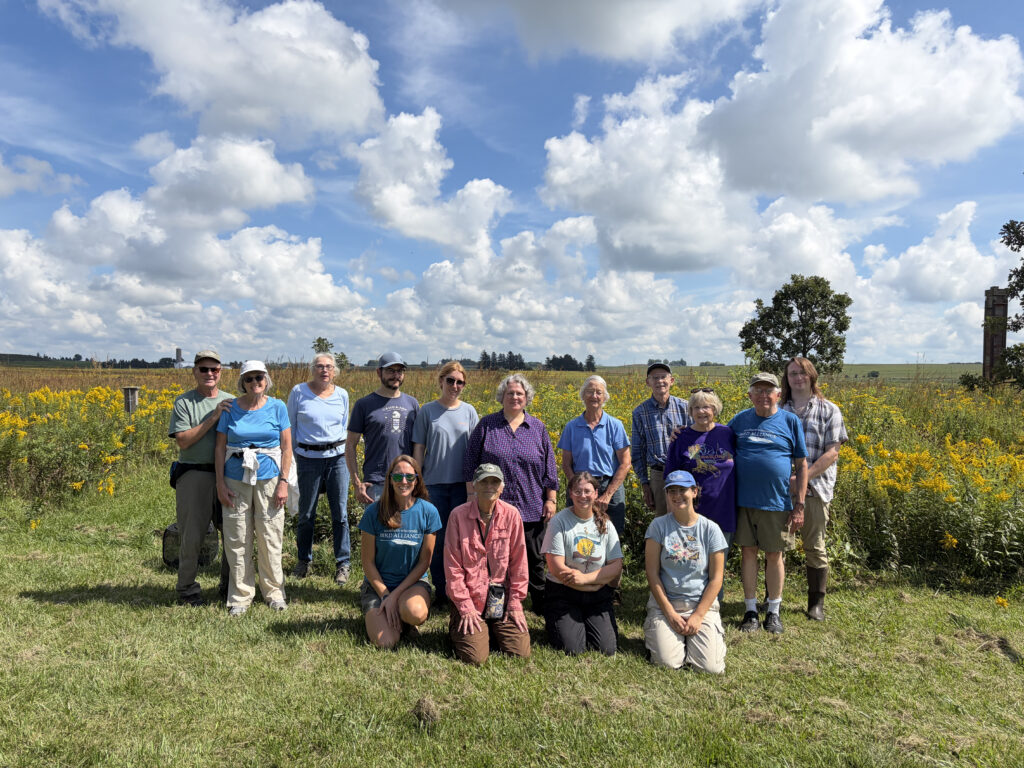
Figure 7: The team of staff, volunteers, and donors who helped tag monarch butterflies at Goose Pond Sanctuary on September 6, 2026. Photo by Brenna Marsicek/SoWBA
Excerpt written by Brenna Marsicek, director of outreach at Southern Wisconsin Bird Alliance
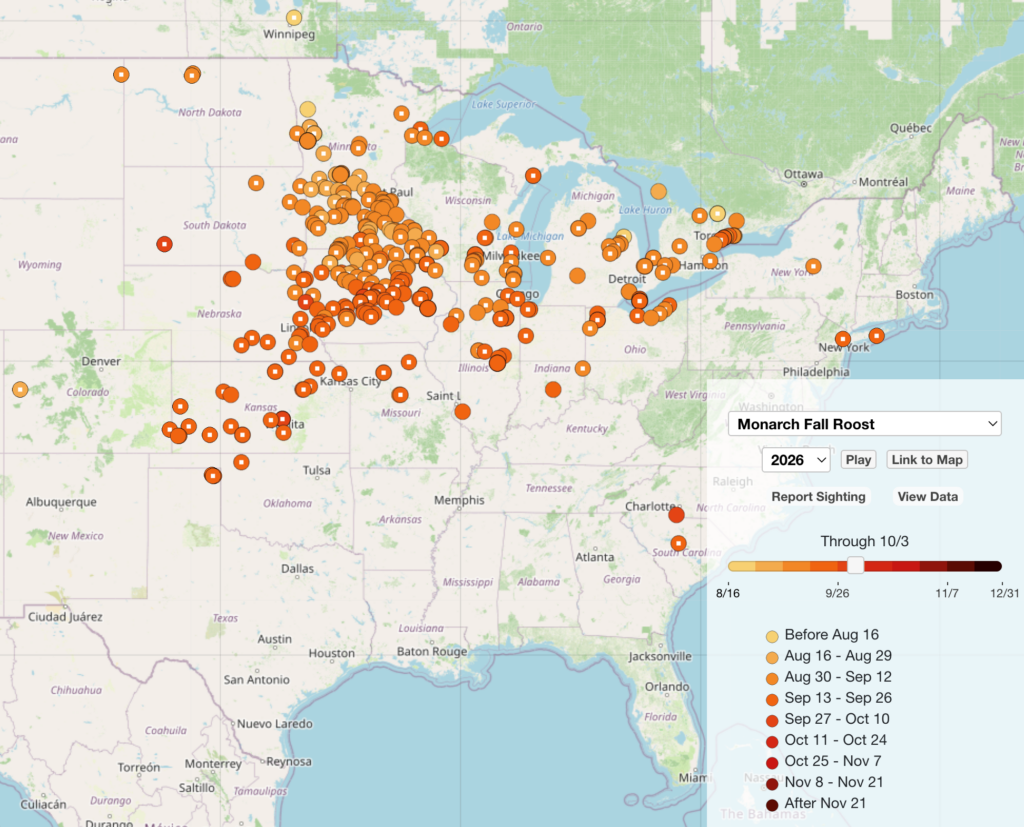
While the Project Monarch monarchs show us a lot about individual pathways, ongoing visual reports from long-standing citizen science projects continue to provide important information. Journey North volunteers have observed monarch roosts as far south as northern Texas (on 9/25), with several reports from Wisconsin (all from before September 18) (Figure 7).
Figure 8. Reports of monarch roosts this fall from Journey North
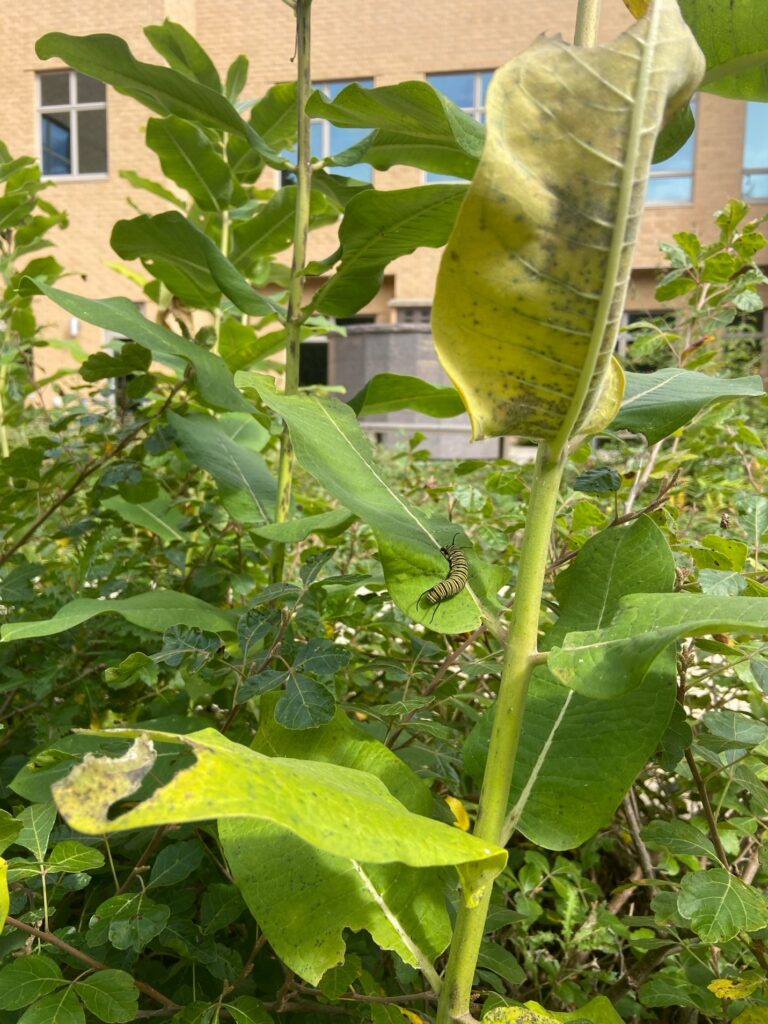
Finally, while adult monarchs are enthralling observers as they move southward, there are still some caterpillar stragglers in Wisconsin. The picture below of a healthy-looking 5th instar monarch caterpillar was taken at Holy Wisdom Monastery in Madison on September 22 (Figure 9). While this late bloomer might not become an adult in time to find enough nectar to power its flight south, it might, adding even more to the story of variation in monarch life cycles. In any case, it has already survived incredible odds; Monarch Larva Monitoring Project data suggest that only about 5% of eggs make it to the 5th instar.
Figure 9. A healthy 5th instar in Middleton, WI on Sept. 22. Photo by Amy Alstad
All of the maps included in this update are screenshots of maps on the Project Monarch app: https://projectmonarch.
Thanks to everyone with blue-tooth enabled phones who have provided the data for Project Monarch, Project Monarch developers and supporters, Goose Pond Sanctuary taggers, and Journey North volunteers for providing the above data.
If you’d like to learn more about Project Monarch, join the Monarch Joint Venture for a special Ask an Expert event featuring two voices in monarch conservation and tagging: Dr. Kristen Baum and Dr. David La Puma. This live event offers an opportunity to hear from both experts as they answer your questions, share insights from their careers, and explore monarch tagging, movement ecology, and its effects on conservation.